Telephone
A device for distant voice communication via electronic signals.

A telephone, commonly shortened to phone, is a telecommunications device that enables two or more users to conduct a conversation when they are too far apart to be easily heard directly. It converts sound, typically the human voice, into electronic signals transmitted via cables and other communication channels to another telephone, which reproduces the sound.
- First device to transmit voice via elect
- Johann Philipp Reis telephone (1861)
- Key components
- Microphone (transmitter) and earphone (receiver)
- Modern dominant type
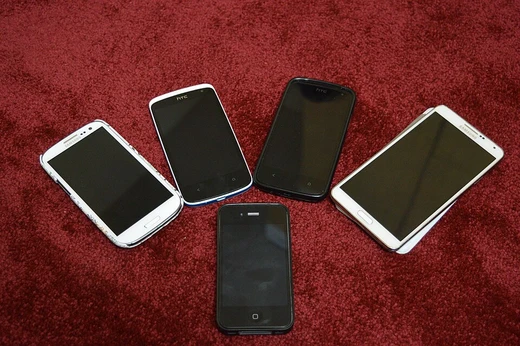
- Smartphone
Lore & Background
Before the electric telephone, the term was applied to other inventions. Credit for the invention of the electric telephone is frequently disputed, with Charles Bourseul, Antonio Meucci, Johann Philipp Reis, Alexander Graham Bell, and Elisha Gray among those credited. Alexander Graham Bell was the first awarded a U.S.
Reader's Guide
The telephone's significance lies in its transformation of long-distance communication. The essential elements—a microphone to speak into and an earphone to reproduce sound—were built into a handset. Early telephones were directly connected, but quickly replaced by manually operated switchboards, which evolved into an automated worldwide public switched telephone network. Analog cellular systems later evolved into digital networks, leading to the smartphone, the dominant type today. Modern telephones exist in fixed-line, cellular, satellite, and Internet-based forms, all integrated into the PSTN, allowing any telephone to reach another through a unique number. Some Internet-based services like VoIP may not always be directly connected to the PSTN.
Did You Know?
- Johann Philipp Reis publicly demonstrated the first device to transmit a voice via electronic signals in 1861, using the phrase 'Das Pferd frisst keinen Gurkensalat.'
- In the United Kingdom, 'blower' is slang for a telephone, derived from navy slang for a speaking tube.
From Stagecoaches to Satellites: A Shifting Vocabulary
The phrase we now use to describe communication technology carries a surprisingly long and fluid history. Before the nineteenth century, 'means of communication' referred almost exclusively to physical infrastructure—railways, roads, canals, post riders, and stagecoaches. In 1861, the economist Albert Schäffle widened the definition to cover aids for circulating goods and financial services, explicitly naming newspapers, telegraphy, mail, courier services, and commercial paperwork such as invoices and bills of lading. By 1895, the German newspaper Deutsches Wochenblatt noted that technical means of communication had advanced so dramatically that 'everyone all over the world has become our neighbor.' The word 'medium' itself did not become a synonym for these technical tools until the twentieth century, and the compound 'mass media' only gained real currency in the 1920s. This slow semantic migration reveals how deeply devices like the telephone reshaped what people even considered a 'means of communication' in the first place.
Natural Versus Technical Channels
Scholars draw a fundamental line between natural and technical means of communication. Natural, or 'primary,' media include everything the human body produces without external tools: speech, screams, sign language, winking, applause, gestures, facial expressions, flag signals, and even the codes embedded in clothing, food culture, and architectural styles. Technical means, by contrast, rely on constructed instruments—writing characters on paper, printing technology, tape recorders, projectors, and transmission systems such as the telephone, telegraph, satellite radio, email, fax, and mobile phones. Within corporate and institutional settings, structured documents like feasibility studies, financial analyses, contracts, and scientific publications also function as deliberate channels of information. The telephone sits squarely in the technical category, specifically as a device for transmitting speech to a single addressee, which distinguishes it from broadcast systems designed to address vast audiences simultaneously.
How Theory Sorts the Channels
Communication theory organizes means of communication along several analytical axes. First, models distinguish audiences by scale—individual, group, and mass communication—each demanding different technical and social arrangements. Second, the theory separates natural from technical components, recognizing that a whispered conversation and a satellite radio broadcast operate on entirely different physical principles. Third, speech itself is broken into verbal and nonverbal components, acknowledging that tone, gesture, and imagery carry meaning alongside words. Looking ahead, theorists propose categorizing media by function: data storage, broadcasting, and processing, with emphasis on the ability to record, reproduce, and reduplicate content. A further hierarchy classifies media as primary, secondary, tertiary, or quaternary based on the technology employed by both sender and recipient. The telephone, as a point-to-point transmission tool, occupies a distinct niche in these frameworks, unlike broadcast or storage media.
Mass Reach and the Analog-to-Digital Shift
Mass media is defined by its capacity to deliver the same information to many recipients simultaneously from a single—or even fractional—sender. This encompasses printed products ranging from books and pamphlets to newspapers and posters, radio broadcasting of language and music via radio waves, and television's combined transmission of visual images and sound. The Internet represents the most recent link in a long chain of communicative innovation. Because of their wide dissemination, mass media are uniquely suited to informing the majority of a population at once. On the electronic side, telecommunications developments have enabled long-distance communication through both analog and digital channels. Analog systems encompass certain radio configurations, historical telephony, and legacy television broadcasts, while digital telecommunications support computer-mediated communication, telegraphy, computer networks, digital radio, digital telephony, and digital television. The telephone's own evolution from analog to digital mirrors this broader technological transition.
More in Communication & Media 1-19
Spotted an error? Know more?
This is a living reference — every entry is fact-audited, and reader corrections feed straight into our audit queue. Suggest an edit · See this site's audit record